What Does a SOC Analyst Do? A Beginner-Friendly Guide for Transitioning Service Members
For many service members exploring cybersecurity, one of the first job titles they come across is SOC Analyst.
At first, the role may sound highly technical or hard to understand. But for many transitioning service members, the basic structure of the job may feel more familiar than expected.
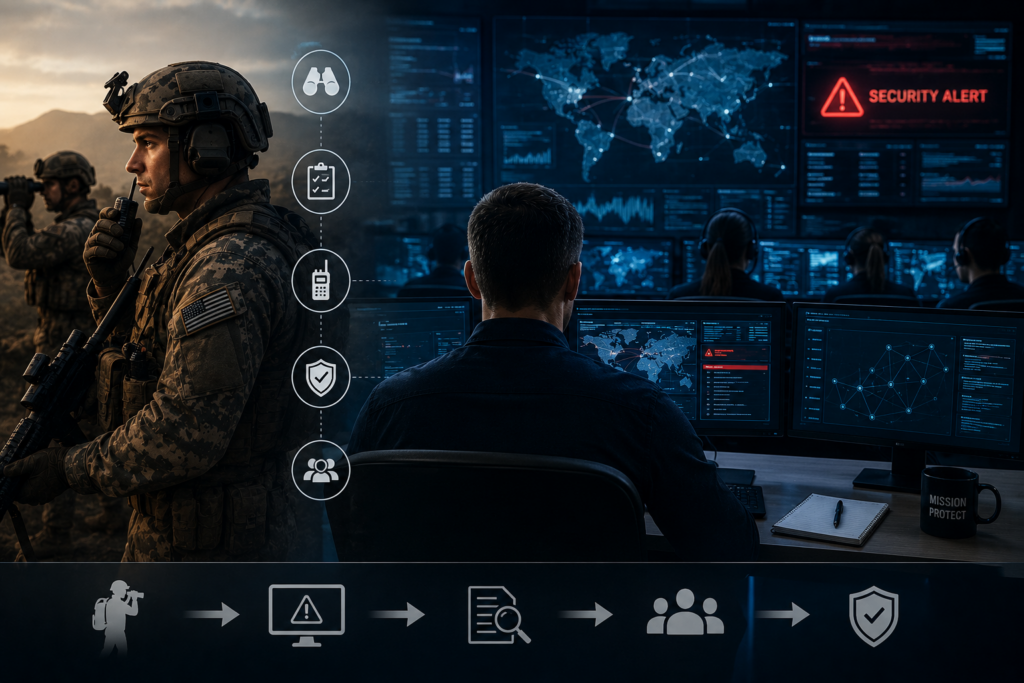
A SOC Analyst works in a Security Operations Center, often called a SOC. The SOC is the team or environment responsible for monitoring an organization’s systems, reviewing security alerts, investigating suspicious activity, and helping respond to potential cyber threats.
In short, a SOC Analyst helps watch over an organization’s digital environment.
So for service members who are used to watchstanding, monitoring activity, following procedures, reporting issues, and staying alert under pressure, SOC work can be a strong entry point into cybersecurity.
At F3USA, our DoW SkillBridge cybersecurity program also helps transitioning service members prepare for cybersecurity career paths through training, certification preparation, workforce development, and career support.

What Is a SOC?
A SOC, or Security Operations Center, is a team that helps protect an organization from cyber threats.
The SOC may monitor:
- Networks
- User accounts
- Servers
- Devices
- Applications
- Security tools
- Logs
- Alerts
- Suspicious activity
In short, the goal is to notice problems early, investigate what is happening, and help the organization respond before a small issue becomes a major incident.
A SOC can be compared to a digital command center.
Just as military teams monitor physical environments, communication systems, equipment, or mission activity, a SOC monitors digital systems and security events.
What Does a SOC Analyst Actually Do on the Job?
A SOC Analyst helps identify, review, and respond to possible security concerns.
Daily tasks may include:
- Reviewing security alerts
- Checking logs and system activity
- Investigating suspicious behavior
- Documenting findings
- Escalating serious issues
- Following incident response procedures
- Communicating with team members
- Using security monitoring tools
- Looking for patterns or unusual activity
- Helping protect sensitive systems and data
Still, not every alert is a real threat. So part of the job is learning how to separate false alarms from issues that need attention.
That also requires patience, focus, curiosity, and good judgment.
Why SOC Analyst Roles Can Suit Transitioning Service Members
Many service members already have habits that can translate well into SOC work.
For example:
- Standing watch translates to monitoring alerts and system activity.
- Likewise, following procedures translates to using response playbooks and escalation steps.
- Reporting incidents translates to documenting findings and communicating with the security team.
- Staying calm under pressure also translates to responding to possible security events without panic.
- Finally, mission awareness translates to understanding that cybersecurity protects people, systems, and operations.
However, this does not mean SOC work is easy. Technical skills still matter. But the mindset of staying alert, following protocols, and protecting the mission can be very useful.
What Skills Does a SOC Analyst Need?
A beginner SOC Analyst does not need to know everything on day one, but there are important foundational skills to build.
These may include:
- Basic cybersecurity concepts
- Networking fundamentals
- Operating system knowledge
- Log analysis
- Alert review
- Incident documentation
- Communication skills
- Problem-solving
- Basic scripting or command-line familiarity
- Understanding of common cyber threats
- Familiarity with security tools
Also, SOC Analysts often use tools that help collect and review security data. This is where platforms like Splunk can be helpful because they teach students how to search, analyze, and understand logs and events.
What Is a Security Alert for a SOC Analyst?
A security alert is a notification that something may need attention.
For example, an alert might appear if:
- Someone tries to log in too many times
- A user logs in from an unusual location
- A system behaves strangely
- Malware may be detected
- A suspicious file is opened
- A device connects unexpectedly
- Network activity looks unusual
The SOC Analyst’s job is not to panic when an alert appears.
Instead, the job is to investigate.
They may ask:
- What happened?
- When did it happen?
- Which system or user was involved?
- Is this normal behavior?
- Is there evidence of a real threat?
- Does this need to be escalated?
- What should be documented?
For this reason, attention to detail matters so much.

What Is Log Analysis?
Logs are records of activity inside systems, networks, applications, and devices.
A log might show things like:
- Login attempts
- File access
- Network connections
- System errors
- Security events
- User activity
- Changes to settings
So SOC Analysts use logs to understand what happened.
Think of logs like a digital paper trail. They also help security teams piece together events and identify whether something is normal, suspicious, or dangerous.
For transitioning service members, this can also be similar to reviewing reports, activity logs, shift notes, or incident documentation.
What Is Incident Response for a SOC Analyst?
Incident response is the process of handling a possible or confirmed security issue.
A SOC Analyst may not be the person making every major decision, especially in an entry-level role. But they may be involved in the early steps, such as:
- Detecting suspicious activity
- Gathering information
- Documenting what happened
- Notifying the right team members
- Escalating the issue
- Following response procedures
- Supporting the investigation
In fact, good incident response depends on clear thinking, good communication, and following the right process.
Those are also areas where many service members already have valuable experience.
What Certifications Can Help With a SOC Analyst Path?
For someone preparing for SOC Analyst work, certifications and technical training can help build a stronger foundation.
F3USA currently promotes training connected to:
First, Security+ can help students understand cybersecurity fundamentals.
Next, Linux+ can help students become more comfortable with operating systems, commands, permissions, and system-level thinking.
Finally, Splunk can help students understand how to search and analyze data, which is especially useful for security monitoring and alert investigation.
Overall, these areas can support someone preparing for security operations and entry-level cyber roles.

Is SOC Analyst an Entry-Level Cybersecurity Job?
SOC Analyst is often considered one of the more common entry points into cybersecurity, but that does not mean every SOC role is the same.
Some SOC Analyst jobs are beginner-friendly. However, others may require prior IT experience, certifications, security tool experience, or a stronger technical background.
So service members should read job descriptions carefully and pay attention to:
- Required certifications
- Required years of experience
- Tools listed
- Operating systems mentioned
- Networking knowledge
- Clearance requirements, if any
- Shift expectations
- Remote or onsite requirements
Even if a service member is not ready for a SOC role immediately, related roles like help desk, IT support, cyber technician, or systems support can also be valuable stepping stones.
What Makes a Good SOC Analyst?
A good SOC Analyst is not just someone who knows tools, but also someone who can:
- Stay focused
- Ask good questions
- Follow procedures
- Communicate clearly
- Document carefully
- Keep learning
- Think critically
- Stay calm during uncertainty
- Work as part of a team
- Understand the importance of the mission
Cybersecurity is a technical field, but it is also a human field.
The best analysts are not just clicking through alerts. They are also thinking about what the alerts mean and how to protect the organization.
How F3USA Helps Service Members Prepare
F3USA is a veteran-founded nonprofit helping active-duty service members transition into cybersecurity careers.
Through our DoW SkillBridge cybersecurity program, F3USA supports students with training, certification preparation, workforce development, and career support.
For service members interested in roles like SOC Analyst, Cyber Technician, Systems Administrator, or related cyber and IT pathways, F3USA also helps build the foundation needed to take the next step.
Final Thoughts on SOC Analyst Roles
In short, a SOC Analyst role can be a strong cybersecurity pathway for transitioning service members.
Overall, the work involves monitoring, investigation, documentation, communication, and response. While the technical tools may be new, the mindset may feel familiar to many who have served.
If you are disciplined, detail-oriented, mission-focused, and willing to keep learning, SOC work may be worth exploring as part of your military-to-cybersecurity transition.
How to Apply
If you are an active-duty service member within 180 days of transition and are interested in cybersecurity training through F3USA, visit the application page:
Frequently Asked Questions
SOC stands for Security Operations Center. It is a team or environment focused on monitoring, detecting, investigating, and responding to cybersecurity threats.
It can be a strong path for service members because it values discipline, attention to detail, communication, alertness, and the ability to follow procedures.
Many entry-level SOC Analyst roles do not require advanced coding, but technical knowledge is still important. In addition, familiarity with operating systems, networking, logs, and security tools can be very helpful.
Certifications and training connected to Security+, Linux+, and Splunk can help build useful foundations for security operations work.
F3USA’s DoW SkillBridge cybersecurity program helps transitioning service members prepare for cyber and IT pathways through training, certification preparation, workforce development, and career support.
Yes, the F3USA SkillBridge Cybersecurity Program is 100% virtual. Classes are held Monday through Friday via Zoom.
Subscribe to our Newsletter
Stay connected with us for updates on program milestones, upcoming events, and the latest success stories from our growing cyber force.
About F3USA
F3USA is a veteran-founded 501(c)(3) non-profit organization. Our Cybersecurity Program is free of charge for all transitioning service members.
EIN: 99-4886744
All contributions are tax-deductible to the extent allowed by law.
