How Corporate Partners Can Support Veteran Cybersecurity Training
Corporate partners who invest in veteran cybersecurity training are not just fulfilling a social mission. They are also building access to a pipeline of prepared, screened, and mission-oriented talent before those candidates enter the open job market.
The cybersecurity workforce shortage is one of the most significant workforce challenges facing American businesses today. As a result, organizations across nearly every sector are competing for a limited pool of qualified cybersecurity professionals. These sectors include defense, healthcare, finance, technology, and critical infrastructure.
At the same time, tens of thousands of highly trained, disciplined, and mission-ready service members transition out of the military every year. They are often looking for meaningful civilian careers in fields that match their skills.
This is not a coincidence, but an opportunity.

Why Corporate Partners Matter in Veteran Cybersecurity Training
Nonprofit organizations like F3USA can deliver training, but corporate support significantly amplifies what training programs can accomplish. That support can come through financial contributions, employer partnerships, mentorship, or hiring commitments.
When businesses partner with military-to-cybersecurity training programs, they help:
Sustain program operations that serve active-duty service members at no cost to participants
Signal to the veteran community that the cybersecurity industry is actively interested in their participation
Shape the skills and experience that candidates are building before they reach the hiring stage
Build early relationships with prospective candidates who are preparing specifically for the cybersecurity workforce
Corporate partnership is not charity. Instead, it is a strategic investment in the talent pipeline that will staff cybersecurity roles for years to come.
Ways Corporate Partners Can Support Veteran Cybersecurity Training
There are multiple ways that corporate organizations can engage with and support veteran cybersecurity training programs like F3USA:
Financial support: Corporations can provide direct financial contributions to nonprofit training programs. These contributions help cover operating costs, technology infrastructure, instructors, and curriculum development.
Employer partnerships: Companies can formally partner with training programs as prospective employers. As a result, they can gain access to candidates who are completing cybersecurity training and becoming aware of available roles.
Mentorship programs: Corporate cybersecurity professionals can serve as mentors to transitioning service members. As mentors, they can provide insight into civilian workplace expectations, industry norms, and career pathways.
Mock interviews and resume reviews: Hiring managers and HR professionals can support workforce preparation by participating in mock interview sessions. They can also review resumes and offer practical feedback.
Sharing job postings and opportunities: Communicating open positions to training programs gives candidates a concrete target to work toward. It also gives employers access to screened, prepared candidates.
Guest speakers and industry exposure: Cybersecurity professionals can share their experience and knowledge with training cohorts. This also helps candidates build a realistic understanding of what civilian careers look like.
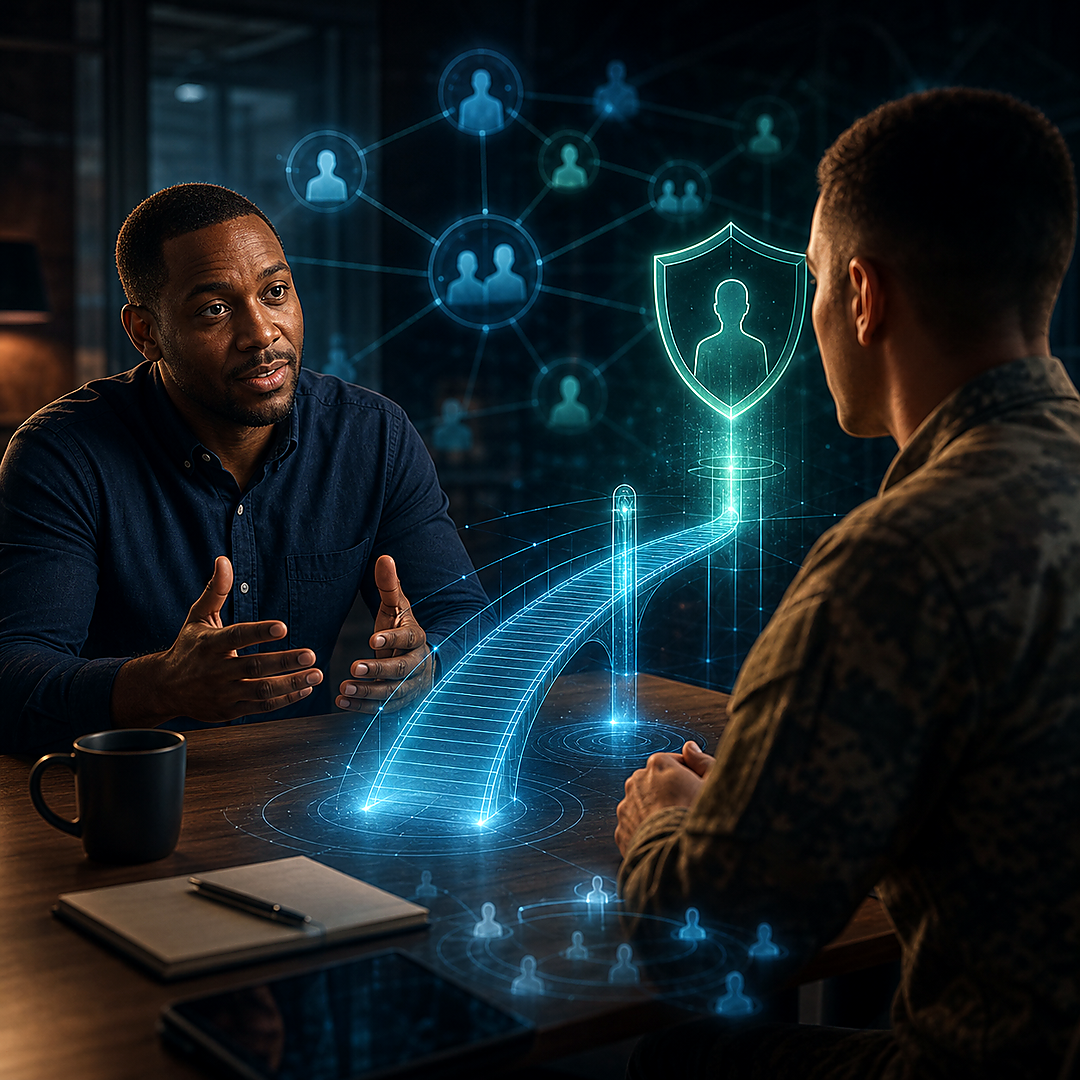
The Business Case for Corporate Investment in Veteran Cyber Training
Corporate leaders sometimes wonder whether supporting veteran cybersecurity training produces real business value. The answer is yes, and for several reasons.
First, the pipeline problem is real. The United States has a significant and growing cybersecurity workforce shortage. According to CyberSeek, there are hundreds of thousands of unfilled cybersecurity roles nationwide. Waiting for the talent to appear in the job market is not a strategy. But building intentional pipelines is.
Second, transitioning service members are a high-quality talent source. Military training instills discipline, accountability, operational awareness, security culture, and the ability to work in structured environments. These are qualities that are difficult and expensive to develop from scratch in civilian hires.
Third, investors, customers, and the public increasingly recognize supporting military-to-cyber pathways as a meaningful expression of social responsibility and national mission. For companies in the defense, government, or public sector space, alignment with veteran workforce programs also strengthens relationships with government clients and stakeholders.

How Partnership With F3USA Works for Corporate Partners
F3USA is a veteran-founded nonprofit. Its focus is helping transitioning service members prepare for civilian cybersecurity careers through DoW SkillBridge training, certification preparation, workforce preparation, and career support.
We are actively building our network of corporate partners and employer partners who share our commitment to the military-to-cybersecurity pipeline. Corporate partnership with F3USA can take different forms depending on your organization’s interests and capacity.
We want to hear from you if you are a large enterprise looking to build a structured veteran hiring pipeline. We also want to hear from mid-size technology companies interested in a mentorship or guest speaker arrangement. The same goes for cybersecurity firms that want to connect with trained, mission-ready candidates as they complete our program.
To learn more about what partnership with F3USA looks like, visit our About Us page or contact us directly through our contact page.
How F3USA Helps Build the Cybersecurity Workforce
F3USA’s DoW SkillBridge cybersecurity program prepares eligible active-duty service members for civilian cybersecurity careers. It does so through 10 weeks of virtual, full-time training and workforce preparation.
The program promotes training connected to CompTIA Security+, CompTIA Linux+, and Splunk. It also promotes cybersecurity fundamentals, technical foundations, and career support designed around the military-to-civilian transition.
Classes meet Monday through Friday via Zoom. The program also comes at no cost to eligible active-duty service members within 180 days of transition.
Corporate partners who engage with F3USA gain access to a pool of candidates who are:
Vetted, trained, and mission-oriented
Prepared for entry-level cybersecurity roles
Building toward recognized industry certifications
Motivated by purpose and prepared for structured professional environments
Partner With F3USA
If your organization is interested in hiring transitioning service members, supporting military-to-cybersecurity pathways, or building a cyber workforce partnership, we invite you to connect with us.
Frequently Asked Questions
F3USA welcomes corporate partners from a wide range of industries. These include technology, defense, healthcare, finance, critical infrastructure, and the public sector. Any organization that needs cybersecurity talent and values mission-driven professionals may also be a strong partner candidate.
Not necessarily. Partnership can take many forms, including financial support, employer engagement, mentorship, or hiring collaboration. Contact F3USA to discuss which type of partnership makes sense for your organization.
Depending on the partnership arrangement, there may be opportunities for corporate partners to engage with candidates during the program. Those opportunities may include guest speaker sessions or career preparation events. Contact F3USA to learn more about what is available.
Supporting veteran cybersecurity training demonstrates a commitment to national security, workforce development, and military community support. For many organizations, alignment with the veteran community and mission-driven programs strengthens relationships with government clients, employees, investors, and the public.
Yes. F3USA is a veteran-founded nonprofit organization. To learn more about our mission and structure, visit our About Us page.
Subscribe to our Newsletter
Stay connected with us for updates on program milestones, upcoming events, and the latest success stories from our growing cyber force.
About F3USA
F3USA is a veteran-founded 501(c)(3) non-profit organization. Our Cybersecurity Program is free of charge for all transitioning service members.
EIN: 99-4886744
All contributions are tax-deductible to the extent allowed by law.
