How to Study for Cybersecurity Certifications While Still on Active Duty
One of the most common questions service members ask when they start thinking about a cybersecurity career is: “Can I actually study for certifications while I’m still serving?” The answer is yes — and starting before you separate is one of the smartest moves you can make.
The cybersecurity job market rewards preparation. Showing up to your job search with a CompTIA Security+ already in hand — or with documented progress toward it — puts you in a fundamentally different position than a candidate who is just getting started after separation. Employers notice that difference.
The challenge is real, though. Active-duty life is demanding. Duty hours, training schedules, deployments, and family obligations leave limited bandwidth. This article gives you a practical, realistic framework for studying for cybersecurity certifications while on active duty — and shows you how the DoW SkillBridge program can give you dedicated full-time training time when you need it most.

Why Starting Before You Separate Is a Strategic Advantage
Starting your cybersecurity certification journey before you leave the military is a strategic move, not just a time-saving one. Here is why it matters beyond the obvious.
When you separate, everything changes at once: your income structure, your daily schedule, your professional identity, and your benefits situation. That is a lot to manage while also trying to self-study for a technical certification exam. Service members who begin their preparation before separation remove one significant variable from an already demanding transition process.
There is also a financial dimension. Tuition Assistance (TA), available through the DoD for eligible active-duty service members, can cover up to 100 percent of tuition costs for approved education programs — up to $4,500 per fiscal year. (Military OneSource) Once you separate, that benefit goes away, and you are funding your own certification preparation.
Starting early also signals intent to civilian employers. If your resume shows that you began cybersecurity certification preparation while still serving, it communicates commitment, discipline, and career intentionality — traits that employers actively value.
Which Certifications to Prioritize While Still Serving
Not all certifications require the same depth of preparation, and not all are equally relevant to entry-level cybersecurity careers. For most transitioning service members, the right focus is a tight, strategic set of credentials rather than a sprawling list.
The three certifications most relevant to entry-level cybersecurity careers — and the ones F3USA’s program specifically prepares you for — are:
CompTIA Security+: The most widely recognized entry-level cybersecurity certification. Required for many government and defense contractor roles under DoD Directive 8140. This should be the first certification most transitioning service members pursue.
CompTIA Linux+: Linux operating systems underpin a significant portion of cybersecurity infrastructure. Proficiency with Linux is expected in many SOC and security operations environments, and Linux+ validates that knowledge formally. (CompTIA)
Splunk Core Certified User: Splunk is one of the most widely deployed Security Information and Event Management (SIEM) platforms in the industry. Listing Splunk familiarity on your resume signals specific tool knowledge that employers in security operations environments look for. (Splunk)
If you can only focus on one while on active duty, make it Security+. If you have more bandwidth, layer in Linux+ study alongside it. Splunk training pairs well with SkillBridge or post-separation programs where you have dedicated time.

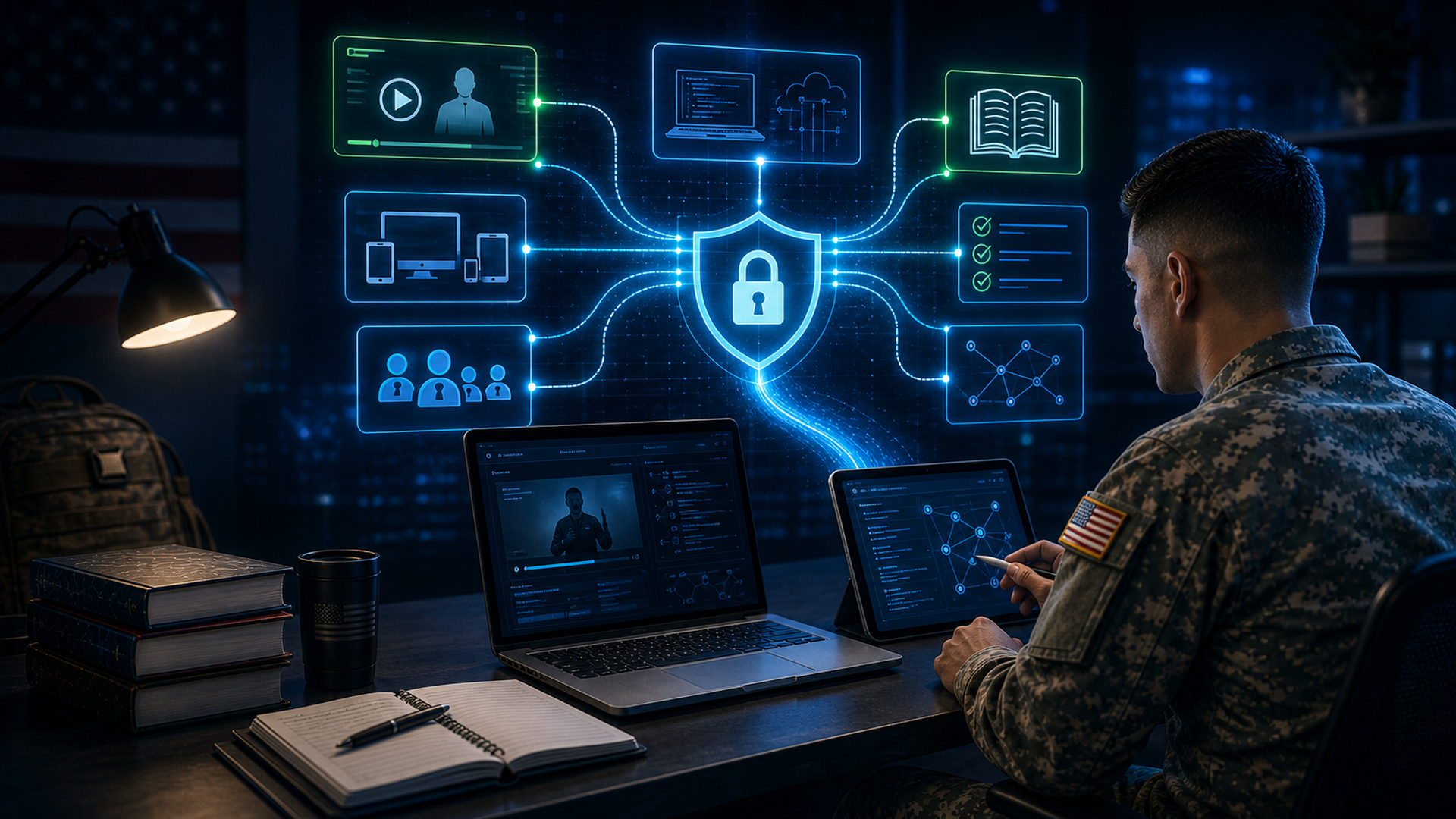
Free and Low-Cost Study Resources Available to Active-Duty Service Members
Cost should not be a barrier to starting. Some of the best cybersecurity certification study resources available are free — and several more are low-cost enough to access without waiting for Tuition Assistance approval.
Professor Messer (professormesser.com): Professor Messer offers free Security+ and Network+ study courses in video format. The content is well-organized, aligns closely with current exam objectives, and is widely used by certification candidates at every level. This is the single best free resource for Security+ preparation.
CompTIA CertMaster: CompTIA’s own official practice platform includes adaptive learning tools, practice exams, and performance-based question simulations. It is a paid resource, but Tuition Assistance may cover it depending on how it is packaged through an approved education provider.
Cybrary (cybrary.it): An online cybersecurity learning platform offering free and subscription-based courses. The free tier includes foundational courses that are useful for building baseline knowledge before diving into certification-specific content.
Udemy: Paid courses on Udemy go on deep discount regularly, often dropping to under $20. Security+ preparation courses by instructors like Mike Chapple and Jason Dion are highly rated and cover exam objectives comprehensively.
Your installation’s education center: Most installations have an education center that can assist with Tuition Assistance applications, connect you with approved providers, and sometimes offer on-base study resources. Visit yours early — the TA application process takes time.
Practical Study Strategies for Active-Duty Service Members
Having the right resources is only part of the equation. Using them effectively within the constraints of active-duty life requires a realistic approach to scheduling and discipline.
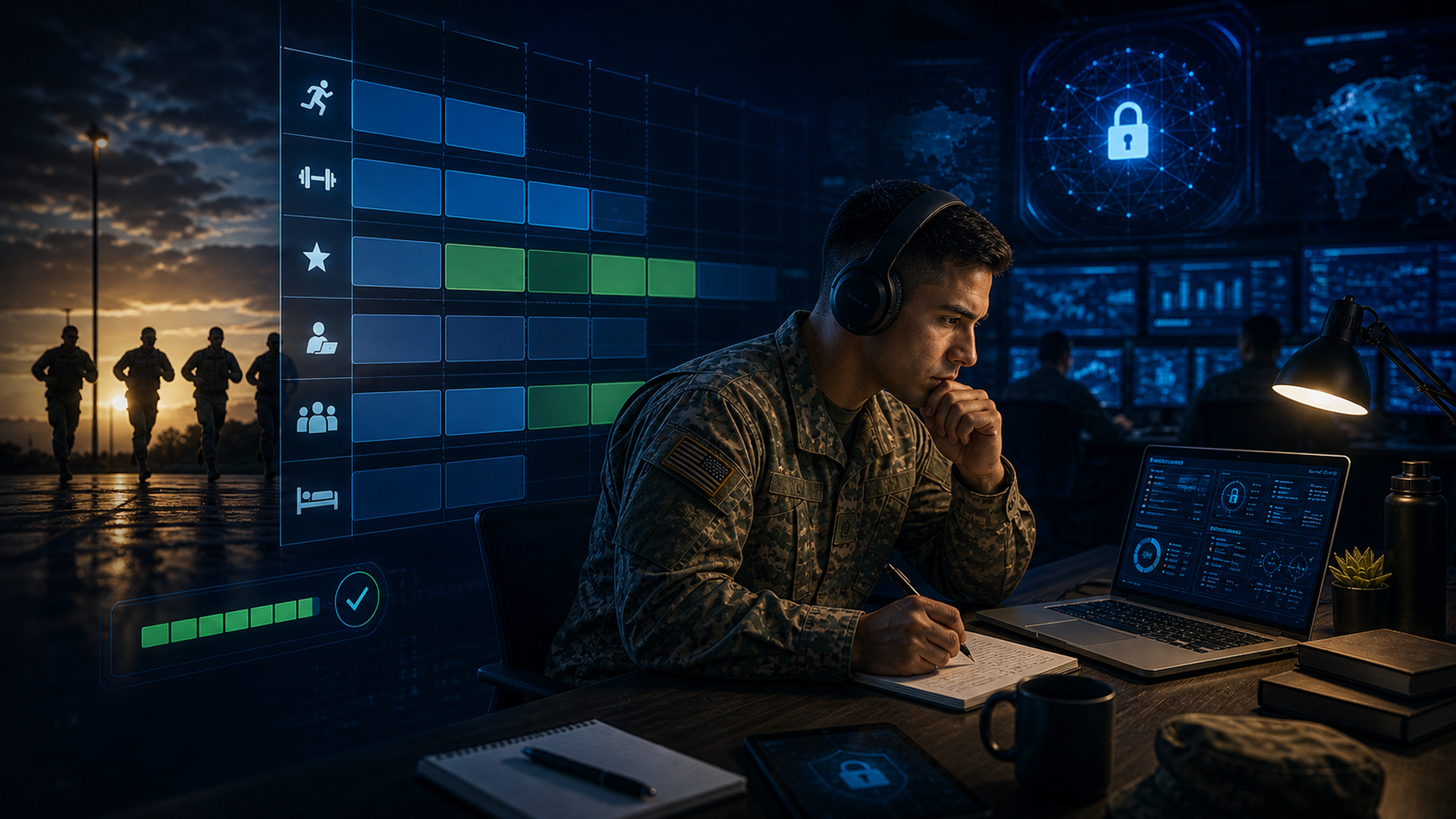
Identify your consistent study windows: Early mornings before PT, lunch breaks, and evenings after duty are the most common study windows for active-duty service members. One to two hours per day is a realistic target. Consistency matters far more than occasional long sessions.
Protect your study time like a duty commitment: The tendency is to treat personal study as something that happens with leftover time and energy. Flip that. Block your study window on your calendar and treat it with the same discipline you bring to a formation or a duty obligation.
Focus on active learning, not passive watching: Watching a video lecture is not the same as learning the material. After each study session, quiz yourself, write a summary from memory, or work through practice questions. Retrieval practice is one of the most effective learning methods available.
Work through practice exams from the start: Do not wait until you feel ready before starting practice exams. Taking practice tests early — even when you get questions wrong — helps you identify gaps faster and familiarizes you with the question format long before exam day.
Form a study group if possible: Other service members may be working toward the same certifications. A peer study group builds accountability, creates opportunities to teach each other content (which deepens retention), and makes the process more engaging.
Take advantage of leave and off-duty periods: Block periods of leave can provide extended, uninterrupted study time. A week of purposeful study leave near the end of your preparation can make a real difference in exam readiness.
How DoW SkillBridge Solves the Time Problem
The biggest obstacle most active-duty service members face when studying for cybersecurity certifications is not motivation or access to resources — it is time. Full-time military service does not leave much room for full-time learning.
The DoW SkillBridge program addresses this directly. SkillBridge allows eligible active-duty service members to participate in full-time civilian career training during the final 180 days of military service, with command approval. Instead of squeezing study in around duty hours, you engage in full-time, structured training while still receiving your military pay and benefits. (SkillBridge.mil)
For cybersecurity certification preparation specifically, this is significant. Full-time, structured training — with live instruction, daily accountability, and a focused cohort environment — prepares candidates far more effectively than self-study carved out of evenings and weekends. SkillBridge converts your final months of service into a genuine career head start.
The catch is that SkillBridge requires command approval, and not every service member will receive it. This is why starting your certification preparation as early as possible — even without SkillBridge — is the right move. Use whatever time you have. If SkillBridge becomes available, use that too.
How F3USA Helps You Prepare for Cybersecurity Certifications Through DoW SkillBridge
F3USA is a veteran-founded nonprofit focused on helping transitioning service members prepare for civilian cybersecurity careers. Our DoW SkillBridge cybersecurity program is built around the certification preparation, technical foundations, and workforce readiness that entry-level cybersecurity roles require.
The program promotes training connected to CompTIA Security+, CompTIA Linux+, and Splunk — in a 10-week, fully virtual format with live instruction Monday through Friday via Zoom. It is offered at no cost to eligible active-duty service members within 180 days of transition.
If you have been trying to study around a demanding duty schedule and making slower progress than you hoped, F3USA’s structured program offers a fundamentally different approach: dedicated time, expert instruction, and a cohort of fellow service members working toward the same goals. Visit f3usa.org/skillbridge to learn more.
How to Apply
If you are an active-duty service member within 180 days of transition and are ready to pursue cybersecurity certification training through F3USA’s DoW SkillBridge program:
Frequently Asked Questions
Most candidates need eight to twelve weeks of consistent study, averaging one to two hours per day. Candidates with a relevant military background in IT, communications, or security may find some domains more accessible and can sometimes prepare in six to eight weeks. Candidates from non-technical backgrounds should plan for the longer end of that range, particularly for the cryptography and security architecture domains.
Yes, in many cases. DoD Tuition Assistance covers up to 100 percent of tuition costs for approved education programs for eligible active-duty service members, up to $4,500 per fiscal year. Specific eligibility depends on your branch and the course you are enrolled in. Visit your installation’s education center or Military OneSource for guidance on what qualifies and how to apply.
Retaking the exam is straightforward. CompTIA allows candidates to retake Security+ after a waiting period. There is no limit on the number of retakes. Review your performance feedback, focus additional preparation on your weaker domains, and approach the retake with a clear plan. Many successful cybersecurity professionals did not pass on their first attempt.
Both approaches can work, but structured courses — especially those with live instruction and cohort accountability — tend to produce better outcomes for most candidates. Self-study requires strong self-discipline and the ability to identify and fill your own knowledge gaps. Structured programs provide external accountability, expert guidance, and a built-in support system.
Absolutely. Starting early is always an advantage. If you are more than 180 days from your transition date, SkillBridge is not yet an option, but self-study using free resources, Tuition Assistance-funded courses, and consistent daily study time can build a strong foundation. The earlier you start, the better prepared you will be when it matters most.
Not every request for SkillBridge participation is approved, and that is a reality many service members face. If command approval is denied, focus on self-study using the resources available to you, use any remaining Tuition Assistance, and continue building toward certification independently. The goal — entering the civilian cybersecurity workforce prepared — remains achievable through multiple paths.
No. F3USA’s DoW SkillBridge cybersecurity program is designed for transitioning service members who are building toward certification, not for those who have already completed it. The program meets you where you are and provides the structured training needed to develop your foundation and work toward certification readiness.
Subscribe to our Newsletter
Stay connected with us for updates on program milestones, upcoming events, and the latest success stories from our growing cyber force.
About F3USA
F3USA is a veteran-founded 501(c)(3) non-profit organization. Our Cybersecurity Program is free of charge for all transitioning service members.
EIN: 99-4886744
All contributions are tax-deductible to the extent allowed by law.
