How to Prepare for a Cybersecurity Interview After Military Service
Getting to the interview stage is a real achievement. But many transitioning service members find that interviewing in the civilian world feels very different from what they experienced in the military. Without intentional cybersecurity interview preparation, even highly qualified candidates can underperform.
Civilian cybersecurity interviews typically involve technical questions, behavioral questions, and sometimes practical exercises, each testing a different aspect of your readiness.
This article breaks down what cybersecurity interview preparation looks like for transitioning service members. It covers what types of questions to expect, how to present military experience effectively, and how to position yourself as a strong entry-level candidate.
What a Cybersecurity Interview Typically Looks Like
Cybersecurity interviews vary by employer and role, but most include some combination of the following:
Technical questions: Questions about networking concepts, operating systems, security principles, common threats, and cybersecurity tools. For entry-level roles, interviewers are often testing foundational knowledge rather than deep expertise.
Behavioral questions: Questions about how you have handled situations in the past. These are designed to assess how you think, communicate, and operate under pressure.
Scenario or situational questions: “What would you do if…” style questions that test your judgment and decision-making in realistic cybersecurity situations.
Resume walkthrough: Many interviews begin with a walkthrough of your resume, so you should be ready to explain every item clearly and confidently.
Practical exercises (for some roles): Some employers, particularly for SOC Analyst or analyst roles, may include hands-on exercises involving a SIEM tool, a packet capture file, or a hypothetical incident scenario.
Entry-level interviews are generally more focused on foundational knowledge, communication skills, and learning potential than on deep technical expertise. In short, demonstrating that you understand the basics, can communicate clearly, and are genuinely motivated to build a career in cybersecurity goes a long way.

Technical vs. Behavioral Interview Questions for Cybersecurity Roles
Understanding the difference between technical and behavioral questions, and preparing for both, is an important part of cybersecurity interview preparation.
Technical questions you might encounter for entry-level cybersecurity roles include:
How does a firewall differ from an intrusion detection system?
What is the CIA triad in cybersecurity?
What is a port scan and why might an attacker use one?
On a typical day, what does a SOC Analyst do?
How do TCP and UDP differ?
What is multi-factor authentication and why does it matter?
Behavioral questions you might encounter include:
Tell me about a time you had to solve a problem under pressure.
Describe a situation where you had to communicate a complex issue to someone without a technical background.
Tell me about a time you identified and corrected a process that was not working.
How do you handle competing priorities and deadlines?
For behavioral questions, the STAR method (Situation, Task, Action, Result) is a widely used and effective structure. Describe a specific situation, what your role was, what you did, and what the outcome was.
How to Translate Military Experience in a Cybersecurity Interview
Military experience is genuinely valuable in cybersecurity. The challenge, however, is presenting it in a way that civilian interviewers understand and appreciate.
Some translation principles for interviews:
Lead with the skill, not the context. Instead of saying “I was responsible for COMSEC in my unit,” say “I managed communications security and encryption protocols for a team of 50 personnel, ensuring secure transmission of sensitive information.”
Quantify where possible: Numbers give your experience scale and credibility, so mention team sizes, systems counts, operational timelines, or scope of responsibility.
Connect military experience to the job requirements: Review the job description and identify which of your experiences most closely match. Then be intentional about drawing those connections during the interview.
Acknowledge the transition: It is okay to acknowledge that you are transitioning into cybersecurity. In addition, pair that acknowledgment with what you are doing about it: training, certification preparation, and genuine engagement with the field.
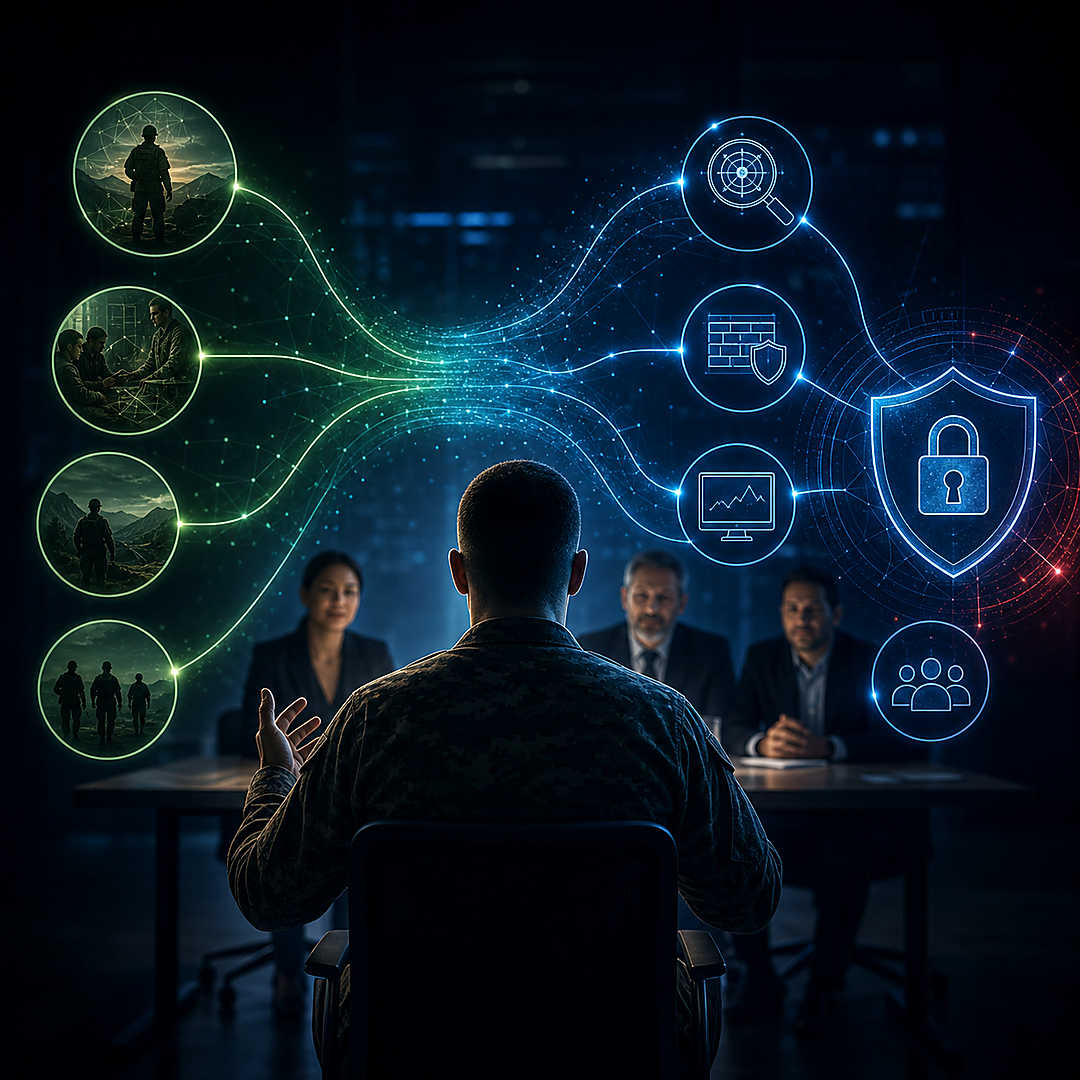

Common Cybersecurity Interview Questions and How to Approach Them
Here are some common questions for entry-level cybersecurity roles, with notes on how to approach them:
“Why cybersecurity?” Be specific. Connect your military experience to the field. Explain what drew you to it and what steps you are taking to prepare. Avoid vague answers.
“Tell me about yourself.” This is not an invitation to recite your resume. Instead, give a brief, relevant summary of your background, your transition, your training, and what you are looking for in a cybersecurity role.
“What certifications do you have or are you working toward?” Be honest and specific. If you are pursuing Security+, Linux+, or Splunk certifications, say so and describe where you are in the process.
“What do you know about our organization?” Research the company before the interview. Also, know what they do, their industry, and any relevant cybersecurity context for their sector.
“Where do you see yourself in five years?” Show ambition without overpromising. Instead, describe a realistic growth path in cybersecurity that starts with the role you are applying for.
How Certifications Support Your Cybersecurity Interview Preparation
Earning or actively preparing for recognized cybersecurity certifications strengthens your interview position in two ways. First, it gives you concrete technical knowledge to draw from when answering questions. Second, it signals to employers that you are serious about the field.
Certifications like CompTIA Security+ cover foundational concepts. These concepts frequently appear in entry-level interview questions: the CIA triad, types of attacks, authentication mechanisms, encryption, and network security fundamentals. Preparing for this certification also means preparing for many of the technical questions you are likely to encounter.
Similarly, knowledge of Splunk and Linux will be relevant in interviews for SOC Analyst and security operations roles, where employers expect some familiarity with the tools used in those environments. (CompTIA, Splunk)
How F3USA Helps Service Members Prepare for the Civilian Cybersecurity Workforce
F3USA is a veteran-founded nonprofit focused on helping transitioning service members prepare for civilian cybersecurity careers through DoW SkillBridge training, certification preparation, workforce preparation, and career support.
Our DoW SkillBridge cybersecurity program goes beyond technical training to address the full scope of workforce preparation. That includes how to present yourself as a qualified cybersecurity candidate, communicate your military background effectively, and understand civilian workplace expectations.
The program is 100% virtual, with classes held Monday through Friday via Zoom. It is currently 10 weeks and is offered at no cost to eligible active-duty service members. Visit f3usa.org/skillbridge to learn more.
How to Apply
If you are an active-duty service member within 180 days of transition and are interested in cybersecurity training through F3USA:
Frequently Asked Questions
Entry-level interviews typically focus on foundational knowledge rather than deep expertise. Expect questions on core concepts like the CIA triad, basic networking, common attack types, and security tools. Demonstrating solid fundamentals and a genuine desire to learn is often more important than having all the answers.
The STAR method is an interview technique: Situation, Task, Action, Result. It helps you structure behavioral interview answers clearly and specifically. Military experience also offers rich material for STAR-format responses.
Yes. Your military background is an asset, but the key is presenting it in civilian language. Explain what you did, the scope of your responsibility, and how those skills relate to the cybersecurity role you are pursuing.
Be honest. Explain that you are currently in training and preparing for certification. Describe what you are studying and what progress you have made. Employers also value transparency and forward momentum.
F3USA’s program includes workforce preparation as a core component of the DoW SkillBridge cybersecurity experience. Contact us through our contact page for specific program questions.
Subscribe to our Newsletter
Stay connected with us for updates on program milestones, upcoming events, and the latest success stories from our growing cyber force.
About F3USA
F3USA is a veteran-founded 501(c)(3) non-profit organization. Our Cybersecurity Program is free of charge for all transitioning service members.
EIN: 99-4886744
All contributions are tax-deductible to the extent allowed by law.
